Monday, September 24, 2012

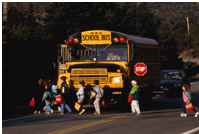
Sharing the Road with School Buses


Now that summer is winding up and many children are heading back to school I’ve noticed a lot more buses on the road. In fact, they seem to follow me around, which is no surprise considering over 480,000 busses operate daily nationwide carrying 26 million elementary school and secondary school students.

Since we are now sharing the road with so many of these oversized vehicles, it is important to understand how to drive properly when around them.

When the stop sign extends:
  •  On a divided highway with a barrier or unpaved road separating the lanes, you may continue to drive if you are going in the opposite direction.
  • On a two-lane road all vehicles are required to stop.
  • On a multi-lane road, all vehicles must stop if a paved lane separates the lanes going in different directions.

Bus lights work like traffic lights:
  • If the overhead lights flash yellow, be prepared to stop.
  • If the overhead lights flash red, stop.
  • When the hazard or warning lights are flashing, proceed with caution.

Whether or not you have to stop when the school bus stops, I recommend you always slow down and constantly examine your surroundings. Children can be unpredictable and dart out of nowhere and decreasing your speed is an easy way to increase your reaction time.

Following these extremely simple steps can make a huge difference in the number of children injured yearly. In 2011 there were 22 fatalities, 350-475 broken bones or worse, and 8,500-12,000 minor injuries like scrapes and bruises.

FYI: If potentially saving a child’s life is not enough motivation to stop when a school bus does, you should also know that if caught you can be fined, imprisoned, face a felony charge, and receive five points on your license.

Monday, September 17, 2012

Reducing Your Blind Spot

Some people are graced with height while others, like my mother, are what I like to call “vertically challenged”. At a whopping four feet and ten and a quarter inches (you can’t leave off that quarter inch!) Mommy faces a few daily challenges that don’t always include her inability to reach things on high shelves.


If you wear glasses or contact lenses you may already be aware that the information can be found on your driver’s license. Well my mother’s first license said that she had to sit on a phone book or pillow while driving. Seriously, she could have received an additional fine if she was ever pulled over and not using something to elevate herself!

Okay, okay, I know this post is silly but I have a good point to make, I promise!

I don’t understand the physics behind it but due to her height, or lack thereof, my mother has a larger blind spot when using her side mirrors. To alleviate this issue she has a simple trick, leaning forward.
 
I’m sure everyone has had their fair share of near-misses when trying to change lanes where the honk of a car horn alerts us that there had been a vehicle beside us the whole time. Hey, they don’t call it a blind spot for nothing! Well, once my mother was in the car with me during such an occasion and filled me in on her trick so I gave it a try. Mothers are always right so naturally this time was no different. My visibility increased astronomically as I moved forward slightly and glanced at my side mirror. To this day I do that every time I change lanes and can honestly say those near-misses are nearly gone.

I hope you found this post both educational and entertaining. Stay-tuned for some more personal safety stories! And please feel free to share some of your own tips in the comment section below.

Saturday, September 1, 2012

Labor Day Weekend


As mentioned two months ago in my 4th of Julypost, the holidays are some of the deadliest days for traffic-related fatalities. According to the Florida Safety Council rates of DUI-related deaths rise dramatically over Labor Day Weekend which is why authorities will step up their DUI enforcement this weekend. 

This morning I happened to catch a commercial I have seen in the past. It was part of the “Drive Sober or Get Pulled Over” campaign and I realized that I see this commercial at very specific times during the year. Well now I know why! 43% of Labor Day deaths involve alcohol compared to the 32% during the rest of the year.  Numbers don’t always make the impact they should so click here for some great infographics!

One campaign slogan I am particularly fond of is “the last day of summer shouldn’t mean the end of your life.” Okay, if you’re a child going back to school sometimes it may feel that way but the point is there is no reason to risk your well-being because you are celebrating.

Here are some tips to enjoy a safe Labor Day weekend:
  • If you choose to drink, never drive. Stay where you are or have a designated driver. You not only put yourself at risk but you are also endangering everyone on the road around you.
  •  Wear your seatbelt. You can’t control what is happening in the vehicles around you but you can make sure you are being cautious in your own.
  •  Be aware of drunk drivers. Learn how to spot a drunk driver on the MADD website.
I hope you have a fun holiday weekend! 


Monday, August 27, 2012

MOVE OVER!

Have you seen this sign before? Odds are you have, maybe even with a different
state listed at the top since this law is now enforced across the United States.
These signs seem self-explanatory but how often do you see a vehicle move over by one lane when there is a cop pulling someone else over? Perhaps a better question is how often do you? If you generally ignore this law you are not just risking a ticket and fine, you are risking someone else’s life. Below are answers to several questions you may have regarding this law.


First, what constitutes an emergency vehicle? Originally police cars, fire trucks, and ambulances comprised this list but as of this year the “move over” law was expanded to include tow trucks.

What do I do when I see a stopped emergency vehicle? That’s simple! Move over! If the lights are flashing on a vehicle at the side of the road you must move out of the lanes closest to them.


I can’t move over… Now what!? If you are driving on a one lane road or if changing lanes is impossible or would endanger you, don’t worry. You won’t get a ticket if you cannot accommodate by moving over... You will, however, need to reduce your speed by 20 mph below the posted limit – Yes, if the limit is 25 then 5 is the magic number.    

Understandably, many may ignore the “move over” law because they see that the civil servant is preoccupied with the task at hand and falsely assume they won’t get pulled over. There are many testimonials that prove otherwise and just because you may not get caught every time you don’t move over or slow down does not mean it can’t happen. Disobeying this law results in a maximum fine of $200 which can be raised to $500 if the violation results in property damage. If there is any bodily injury the offense will be enhanced to a Class B misdemeanor.

These individuals are risking their lives to keep citizens safe, yourself included, so why not adhere to the law and do everything in your power to keep them from being mowed down on the job?

Click here to learn more about the “move over” law in detail.


Wednesday, August 15, 2012

School Bus Safety


It's that time of year again. School is back in session! As a parent you have a lot on your plate. Did you buy everything on the list of supplies? Do you have a healthy lunch prepared? The list goes on and on... 

But let's take a moment to discuss something that may not be on the forefront of your mind; that big yellow bus. Statistics show school buses are actually nine times safer than other passenger vehicles during the normal school commute. While this figure may put your mind at ease, the children are the ones who put themselves at risk so it is very important that you educate them. Last year twenty-one children were fatally injured while riding on the bus and as pedestrians near the bus stop. Additionally 475 children obtained major injuries such as broken bones!

Below are some helpful hints to keep your child(ren) safe. 

At the Bus Stop:
  • Always walk to the bus stop. Never run. 
  • Walk on the sidewalk. If there is no sidewalk, walk of the left side of the road facing traffic. 
  • Always go to the bus stop at least 5 minutes before the bus arrives.
  • While at the bus stop, wait in a safe place away from the road. Do not run around and play while waiting
  • Never speak to strangers at the bus stop and never get in a car with a stranger. Always go straight home and tell your parents if a stranger tries to talk to you or pick you up.
  • When the bus arrives watch for red flashing lights and the stop sign to be extended and only cross when all traffic has stopped. 

On the Bus:
  • Go directly to a seat.
  • Remain seated and facing forward for the entire ride.
  • Talk quietly so as not to distract the driver.
  • If you need to talk to the bus driver wait for the bus to stop, raise your hand, and call the driver's name.
  • Never throw things on the bus or out of the windows.
  • Never play with the emergency exits.
  • Keep aisles clear at all times (keep backpacks at your feet).
  • If there is an emergency, listen to the driver and follow instructions.

Monday, August 6, 2012

Road Signs: Colors


Do you remember when you took the test for your driver’s permit? I recall that I needed to memorize what the shapes and colors of road signs meant. I only took my test six years ago but embarrassingly, when I drove home on the interstate, I had no idea what type of information was on the sign unless I read it. 

One of the primary reasons that road signs come in different colors is so when you are too far from them you will know whether or not you need to pay attention to what they say. Sometimes motorists don’t regard all road signs but if you are aware that certain colors are particularly important you may be more likely to read it so I thought I’d do a quick post to reeducate myself and others.

What the sign colors mean…

Green: Guide and directional information
          -These signs will tell you how far you are from an upcoming place
Red:   Stop, yield, do not enter, and wrong way
          -Look out for red signs, they are there for your protection
Blue:  Upcoming services for drivers
          -Displays restaurants, gas stations, and hotels
Orange: Warns of construction and road maintenance
          -Alerts you of the presence of road workers and if
           lanes are closed or 
uneven
Yellow: General warning or caution
          -They warn about hazards, identify your route,
           and direct the speed and
 movement of traffic
White: Regulations, ordinances, and enforceable laws
          -This category includes signs that show the speed
           limit and whether 
u-turns and other turns are
           possible
Brown: Indicates recreational or historical points of interest
          -This color is less urgent and more for leisure information


Was this information useful for you?
Would you like to see more posts like it?
Let me know! I’ll be more than happy to oblige.

Thursday, August 2, 2012

"ICE" Your Cell Phone!


No I’m not talking about bling, although I do appreciate a little bit of sparkle!

ICE stands for ‘In Case of Emergency’ and is a simple and easy way for emergency responders and healthcare workers to contact the right people in case of, well, an emergency situation.

Wallets typically carry one’s license which can help emergency workers identify them and learn about any life-threatening conditions (for example, my photo caption says ‘Insulin Dep’ so they would know I have diabetes). However, my wallet isn’t always on my person and can be buried in my purse and difficult to locate. Cell phones, on the other hand, are almost an extension of some individuals and can be easier to find sometimes.  

When I was in grade school my emergency contacts were always my parents but now I live in a different city than them so if someone was to search for “mom” or “dad” it would really be a waste of time. Additionally, some people may list their parents by name instead of title which wouldn’t really help either. Emergency workers are trained to look for the codeword ICE in your contact list first so they can reach the right person.

So let’s take a minute to pick up our cell phones and create a new contact or edit an existing one. Add ICE in front of your emergency contact’s name. If you have multiple contacts list them as ICE 1, ICE 2, etc. and rank them in order of who would be the most useful. Listing additional people is helpful in case the first person does not answer their phone.

The cool part is if you aren’t carrying identification your contact can see that your phone is calling and alert the emergency worker. 

So help them help you and ICE your phone today!